You know you’ve built something special when a user picks it up and says, “I literally don’t know how they did this.”
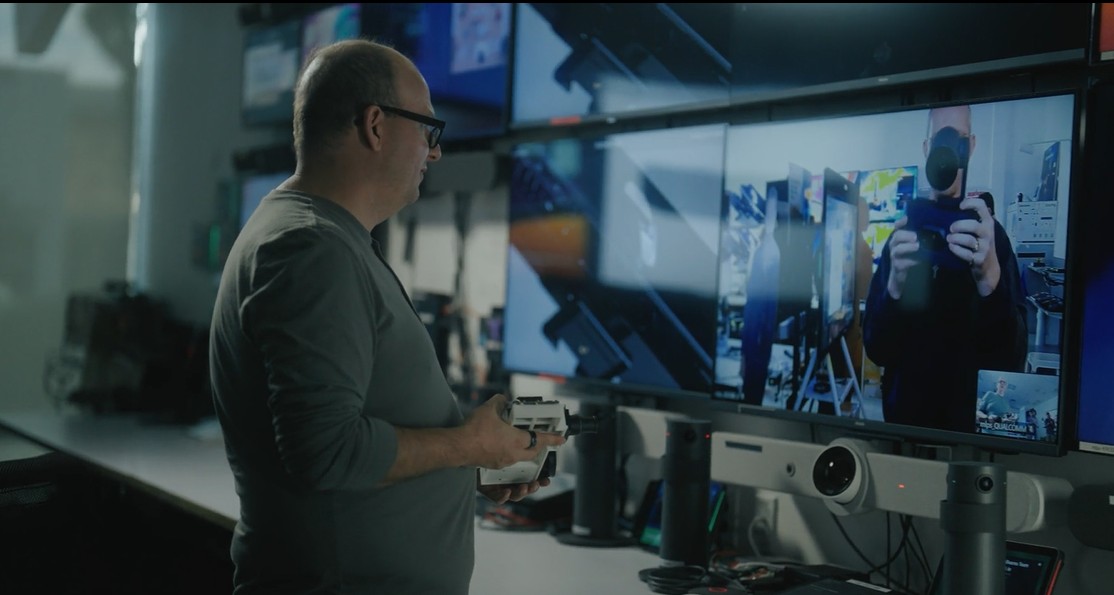
That’s the reaction the engineering team behind the Rally AI Camera and Rally AI Camera Pro was aiming for. In a recent behind-the-scenes look, Karthik Rajagopal, Vijay Karnataki, and Mike Downing opened up about how they solved one of the biggest headaches of hybrid work: the loss of connection. When you’re in a room with seven other people, the video experience rarely feels personal or “one-to-one.”
Here is how the team used custom engineering and a lot of passion to bring intelligence to meeting spaces of all sizes.
Midsize vs. Massive: Solving for Scale
Recently introduced as a next-generation solution, the Rally AI Camera replaces Logitech’s longstanding Rally Camera, bringing smarter framing and enhanced AI to midsize meeting rooms. It’s designed as the ideal fit for midsize rooms where framing is relatively simple. However, even with these more advanced capabilities, the team knew they needed a different beast for larger, more complicated spaces—especially ones with movable furniture or speakers who like to pace around.
Enter the Rally AI Camera Pro. To handle these complex environments, the team packed it with advanced features:
- Deep Optical Zoom: A powerful PTZ (Pan-Tilt-Zoom) camera provides a deep view into large rooms, overcoming the range limitations of smaller cameras.
- Presenter Tracking: If a speaker is moving through the space, the camera follows them automatically.
- Tandem Power: The system can use two cameras working in tandem to improve meeting equity across almost any room configuration.
Custom Optics and “Invisible” Tech
The team was adamant about one thing: they didn’t want to use off-the-shelf, general-purpose lenses. Instead, they custom-designed optics specifically tailored for video conferencing.
But the experience isn’t just about what you see; it’s about what you don’t notice. “Invisible technology” means the device is engineered to disappear into its surroundings, both visually and aurally, so it never distracts from the conversation. Every detail, from the lens design to the precision-tuned four internal motors, serves to keep the audio experience as silent and natural as the visual one.
Designed to Fade Into the Background
Flexibility was a major priority. These cameras aren’t stuck at the front of the room—they can hang from ceilings, sit in corners, or mount on walls.
For the Rally AI Camera, the designers took “invisible technology” a step further. They created a recessed box option with a fabric panel that allows the device to essentially “fade into your architecture,” leaving only the camera opening visible.
Crucially, this hardware is built for the long haul. The engineers ensured the devices have enough computing “headroom” to handle future AI features. This means that as software updates push boundaries, your camera is ready to deliver new experiences without needing a hardware upgrade.
Fueled by Freedom
At the end of the day, navigating modern engineering challenges takes resilience. The team credits their success to a culture that allows them the creative space to collaborate and the freedom to push boundaries.
When engineers are given that freedom, innovation becomes a natural byproduct, resulting in products that solve interesting problems without ever getting in your way.
Learn more about these powerful conference cameras: Rally AI Camera and Rally AI Camera Pro, and watch the moment they were revealed in this episode of the Next Up series.