Stale workplace air can be an invisible energy thief—and how data can help us reclaim our afternoon focus
The clock ticks to 3 p.m., and suddenly, a collective heavy fog rolls over the workplace. You stare at your email like it’s hieroglyphics. Your motivation evaporates, and the temptation to crawl under the desk for a quick nap, George Costanza-style, becomes overwhelmingly strong.
It happens to me and I’ll bet it happens to you. It seems to be a universal office phenomenon.
For years, we’ve blamed this mid-afternoon crash on personal failings: a late-night Hulu binge-watch, a sugar crash, or that extra slice of garlic bread with our lunchtime fettuccine alfredo. A quick skim through Reddit shows that theories abound, from stress to hormone levels.
While our biological circadian rhythm does naturally dip twelve hours after our deepest sleep cycle, science points to another stealthy workplace culprit causing the afternoon slump: the very air we are breathing.
The Invisible Energy Thief: Stale Office Air
Throughout the workday, an invisible transformation occurs within enclosed meeting rooms and workspaces. As a group of people sits together hour after hour, they absorb oxygen and exhale carbon dioxide (CO2). In modern, closed-door office buildings, this CO2 has nowhere to go.
While fresh outdoor air sits comfortably at around 400 parts per million (ppm) of C02, a crowded conference room can easily spike past 1,000 to 2,500 ppm by mid-afternoon.
Leading cognitive studies, including research from Exposure, Epidemiology, and Risk Program, Department of Environmental Health, Harvard T.H. Chan School of Public Health, have shown that these elevated indoor CO2levels can impair human cognitive function. High carbon dioxide accumulation can induce brain fog, lethargy, headaches and a sense of sleepiness.
Combine this with Volatile Organic Compounds (VOCs) from office furniture and stagnant, dry air from HVAC systems, and your workplace can become an incubator for fatigue.
Unmasking the Problem
You cannot fix a problem you cannot see. Because CO2 and VOCs are odorless and invisible, teams usually realize the air quality has degraded only after they are already feeling exhausted.
To combat this, forward-thinking organizations are turning to smart environmental tracking to make the invisible visible.
Imagine an IT or facilities manager tracking room health metrics over time. By using wall-mounted environmental sensors like Logitech Spot, teams can continuously monitor indoor factors like carbon dioxide, dust, and aerosols that quietly drain employee concentration. This data takes the guesswork out of understanding exactly why focus plummets during the afternoon crash.
But this smart sensor doesn’t work only in conference rooms.
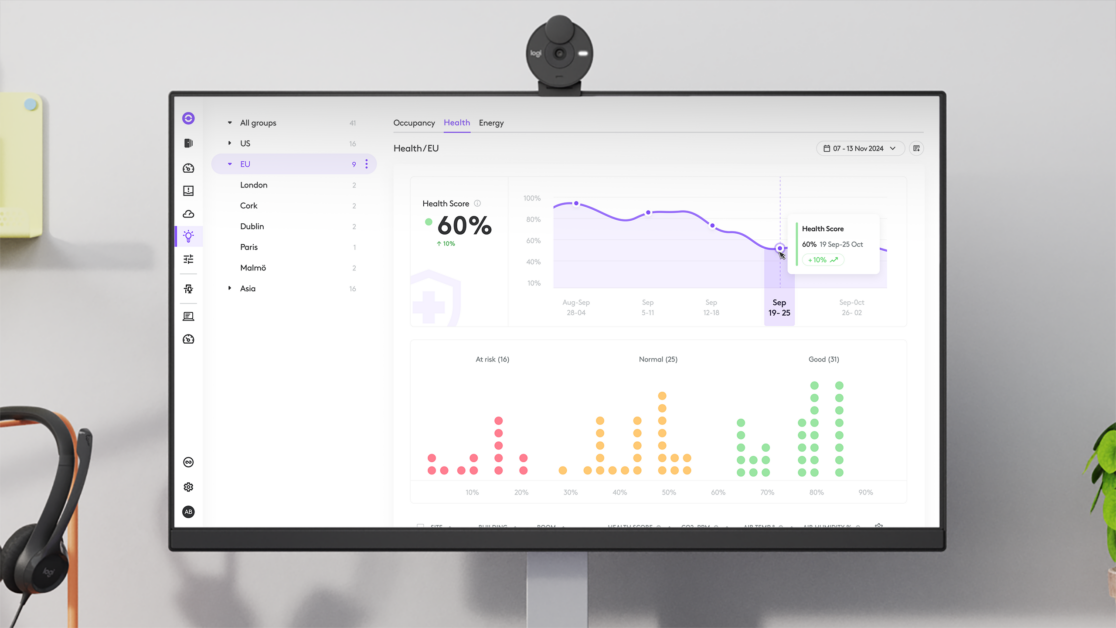
Environmental Sensing for Healthier Collaboration Spaces
Managing air quality is especially crucial in high-stakes collaboration spaces where sustained focus is paramount. To bridge the gap between daily collaborative meetings and environmental awareness, modern hardware is building health tracking right into the room infrastructure.
For example, when a team gathers around an all-in-one video collaboration board like the Logitech Rally Board 65, the device does double duty. While facilitating hybrid communication, its integrated, built-in sensors silently track local room conditions. That information is sent into a dashboard for IT or Facilities teams to see, and if necessary, make changes to the space to help keep everyone awake, alert, and creative.
Reclaiming The Afternoon
The 3 p.m. slump doesn’t have to be an inevitable tax on workplace productivity. By understanding that afternoon fatigue is a mixture of human biology and environmental design, businesses can take proactive steps. Reclaiming your team’s focus requires moving beyond endless cups of coffee to looking at the infrastructure of the workspace itself. Armed with smart, data-driven solutions like Logitech Spot and Rally Board 65, companies can finally clear the air, banish the afternoon fog, and keep their workforce clear-headed and focused through the last, longest stretch of the day.
Sources:
ASHRAE Position Document on Indoor Carbon Dioxide (2025)
CDC NIOSH Ventilation FAQ on CO₂ Monitoring
Harvard/Allen et al. Cognitive Function and CO₂ Study
Harvard Healthy Buildings Research on CO₂ and Cognitive Performance
2023 Meta-Analysis of Indoor CO₂ and Cognitive Performance