Let’s be honest: hybrid work isn’t going anywhere. But while we’ve mostly figured out our schedules, the real headache now falls on IT teams and office planners. How do you make the tech at a hot desk feel just as seamless as a high-powered boardroom? And more importantly, how do you earn the commute so that people actually want to use it?
At InfoComm 2026, Craig Durr (Founder and Chief Analyst of The Collab Collective) sat down with Jedd Williams, the Chief Commercial Officer of Logitech for Business, to chat about exactly that. It turns out Logitech is going way beyond the mice and keyboards on our desks to solve some of the biggest pain points in the modern office.
Here’s a look at where they’re heading.
Moving Beyond the “Mouse House”
If you ask the average person what Logitech does, they’ll probably point to the mouse on their desk. And hey, as Williams joked during the interview, “a mouse built this house.” But today, the the B2B segment makes up about 40% of Logitech’s total revenue, and Williams has a clear mission: push that number past 50%.
To get there, Logitech is shifting how they talk to businesses. Instead of just pitching hardware specs, they’re focusing on the human side of tech—looking at real user habits, different industries, and the actual friction points people face when they walk into a meeting room.
“Don’t Sell Your Org Chart”
One of the coolest insights Williams shared was an internal rule they have at Logitech: “Don’t sell your org chart.” Too many tech companies force buyers to look at their products through isolated business silos. Logitech wants the exact opposite. They see their portfolio as a lifelong journey. You might start out using a Logitech rugged combo for your tablet in grade school, Logitech G gaming headset as a teenager, MX mouse and keyboard in college, and eventually walk into a corporate office completely decked out in their enterprise gear in the conference rooms and desks.
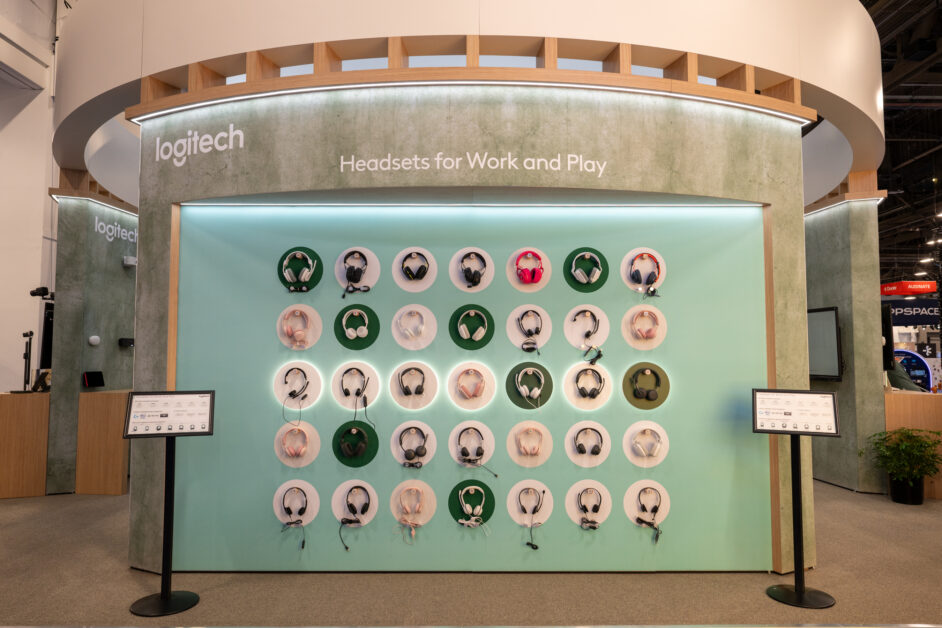
To prove the point, Logitech set up a massive Unified Headset Wall at InfoComm. It featured every single headset they make side-by-side—from bright pink gaming gear to the high-end Zone Wireless 2 built for intense enterprise environments. The message to IT leaders? Stop forcing rigid corporate tech on your employees. If someone works better using a sleek, colorful headset they love, let them use it. Comfort drives productivity.
Leveling Up the Conference Room with AI
Logitech is already a global heavyweight in video conferencing—in fact, data from firms like Synergy Research ranks them #1 globally in video units sold. But keeping that top spot means making video meetings feel less like a chore and more like a natural conversation.
Enter their latest releases: the Rally Camera AI and Rally Camera AI Pro.
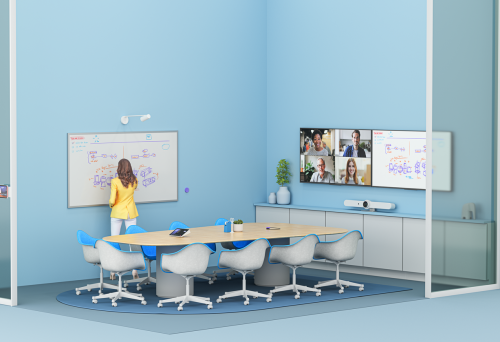
These aren’t just standard conference cameras. They’re modular systems designed to handle the physical layout of a room, using AI to make sure remote participants don’t feel left out. Best of all for office aesthetics? They’re designed to be cleanly mounted right into the wall, keeping the technology hidden so teams can just focus on collaborating, not the tech itself.
Tracking the Whole Office with Logitech Spot
As companies try to optimize their return-to-office setups, a new question has popped up: Are we actually using all this space? It’s easy to track a major conference room, but what about hot desks, open collaboration couches, or quiet phone booths?
To solve this riddle, Logitech introduced Logitech Spot.
It’s a small, clever device packed with radar presence detection and environmental sensors. Because it doesn’t require a full video setup, office planners can place it anywhere—like a row of unmanaged desks—to get precise data on how the office is being used. It takes the guesswork out of real estate decisions.
The “Special Sauce”: Logitech Sync
All of this hardware—from the mouse in your hand to the AI camera on the wall and the Spot sensor in the hallway—is tied together by a platform called Logitech Sync.
Williams calls Sync their “special sauce.” It aggregates all the data and tech management into one dashboard for IT admins. Instead of waiting for an executive to complain that a camera isn’t working, Sync lets IT teams see issues and fix them proactively—usually before anyone even walks into the room for a meeting.
Catch an Event Near You
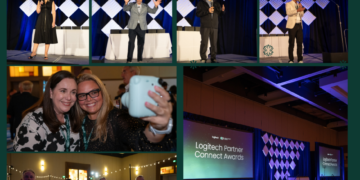
If you want to see how this all connects in real life, keep an eye out for Logitech’s Logi Work global event series. They hit 29 cities last year and are rolling it out again later this year to showcase tailored setups for specific fields like healthcare, education, and government.
At the end of the day, Logitech’s philosophy is simple: if you want to change the corporate conversation, you have to build a better environment for it to happen.