For years corporate leaders fell into a simple trap: they tracked badge swipes to measure whether hybrid workplace policies were actually working. It was an imperfect proxy for performance. Checking a box at the security gate tells you nothing about whether an employee thrives once they step through the door.
Hybrid setups struggle because leaders keep asking how to get people into seats. We should instead ask how to make the time spent in those seats count.
In The Workplace Equation, our latest research study with The Harris Poll that surveyed 1,700 workplace experience leaders across 11 countries, 91% agree that measuring the health and ROI of their workspaces requires cross-referencing real-time spatial analytics (how people move within the space), technology performance and human sentiment. We are moving past the badge swipe toward a metric that shapes the everyday employee experience: workplace flow.
Today 62% of organizations use employee surveys to gauge the workplace, while 34% look at badge data and 32% rely on occupancy sensors. Environmental sensors sit at just 31%.
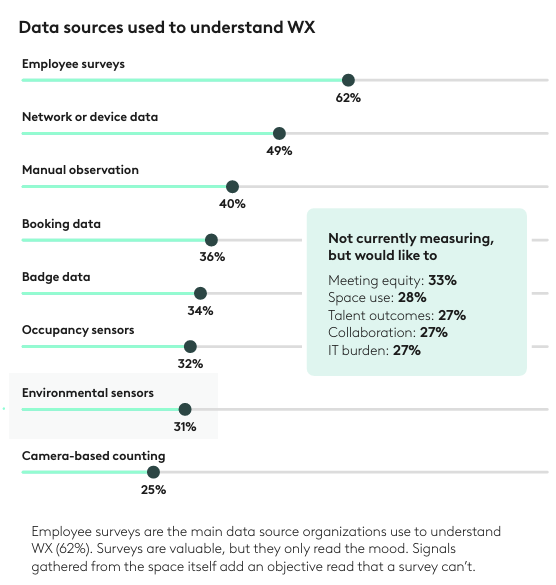
Yet when we ask leaders what information helps them make things better, the answer is rarely raw attendance. They want employee feedback, productivity and collaboration impact, and technology performance.
Friction costs real money, and it drains team morale.
When technology fails in a meeting room, an average of 12 minutes of productivity vanishes per person. Multiply that across an enterprise and you see why 94% of leaders say workplace experience failures hit their bottom line. And it’s not just about technology. Human performance and daily energy are directly influenced by the air we breathe every day. Cognitive studies from the Harvard T.H. Chan School of Public Health reveals that elevated carbon dioxide and particulate levels significantly slow mental response times and reduce decision-making accuracy.
Hardware and software can work in tandem to fix this. Hardware data, paired with environmental intelligence, sheds light on factors affecting workplace flow. Complete that picture with sentiment surveys, and you can stop managing attendance and start supporting real employee performance.
Research from global firms like McKinsey shows that agile workspaces directly boost worker engagement. The leaders winning the hybrid era are not policing calendars. They are designing environments where technology gets out of the way, collaboration happens naturally and people actually want to show up.