By Agnes Lisowska Masson
Does a dull ache in your forearm in the afternoon sound familiar? Or the stiffness creeping up your neck after back-to-back video calls? You’re not alone.
According to a Logitech Ergo survey across 11 countries*, 58% of participants experience pain or discomfort at the end of a work day. And that number rises to 65% in younger demographics (18-34 years old).
The back, neck, forearms and wrists are the most common areas of pain or discomfort. Yet, when we asked people what can improve comfort at the desk, many pointed to ergonomic chairs and standing desks. Mice and keyboards, the very tools they use for eight hours a day to get their work done, barely crossed their minds.
October is Global Ergonomics Month, but workspace wellbeing is not a seasonal trend. We spend hours curating our diets, tracking our sleep and hitting the gym, but we tend to overlook the space in which we spend most of our day. Why do we treat our workspace comfort like an afterthought?
Small Tweaks That Can Ease Everyday Aches
In the Logitech Human Factors Lab, we aim to understand how people interact with their tools and environments, and how small, intentional adjustments can improve comfort throughout the workday. What we see time and time again is that small tweaks to your setup can make a big difference.
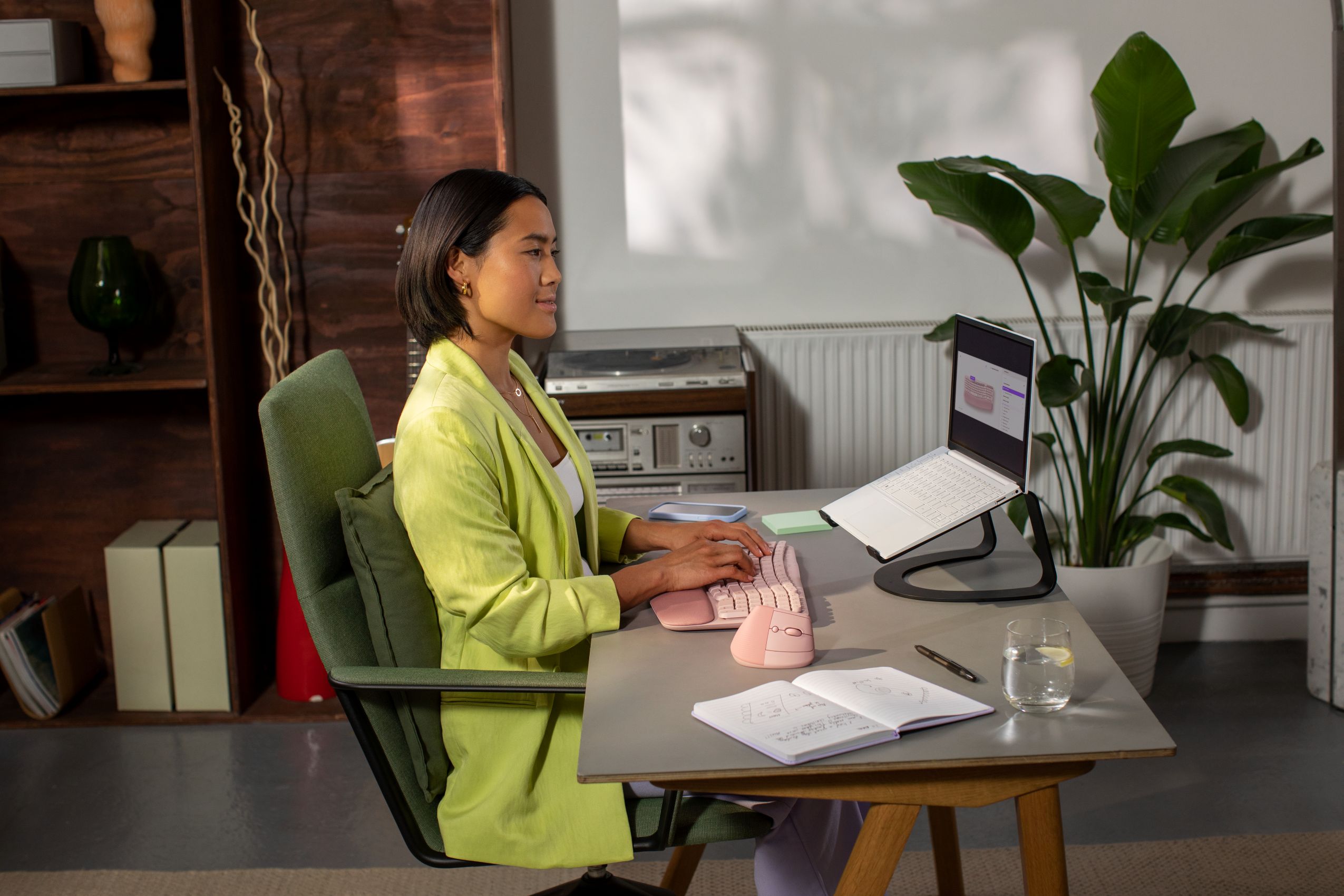
Take the classic laptop experience. Working directly on a laptop for hours a day can put strain on your neck, shoulders and wrists. Why? Because with a laptop the screen, keyboard and trackpad are all in a fixed position, meaning you can’t adjust them individually to optimize comfort. There are three simple adjustments to boost comfort and improve posture:
- Raise your laptop to eye level using either a stack of books or a laptop stand. It’s a great way to avoid “tech neck.”
- Add an external keyboard and mouse so you can adjust them to suit your comfort and space.
- Choose input tools tailored to your hand size and frame, like a mouse designed for smaller hands or a shorter keyboard that puts your shoulders and elbows in a more natural position.
How Logitech Leaders Build Their Workspace Routine
Ergonomics is not one-size-fits-all. I talked with some of our leaders across Logitech’s Personal Work Solutions team to see how they bring workspace wellbeing into their daily routine.
Years ago, Delphine Donné, Vice President and General Manager of Personal Work Solutions at Logitech, was using her favorite keyboard and mouse for work. It felt like the perfect setup, but over time she realized it wasn’t the best ergonomic fit for her.
“It turned out, the keyboard I was using was too wide for my frame. I changed to a smaller keyboard, without a number pad, and within a week, the pain I had for a while was gone,” said Donné.
Art O’Gnimh, Vice President and General Manager of the Mice & Keyboard Solutions business unit at Logitech, focuses on the micro-habits that prevent physical discomfort during heavy focus blocks.
“When I’m at the office, I usually have a packed meeting schedule, so I try to build intentional movement into my day. That can mean taking a few minutes to stand up and stretch between meetings or finding another room to change my surroundings. It’s a small habit, but it goes a long way in beating that afternoon slump, preventing stiffness and improving circulation,” said O’Gnimh.
Rethink Your Desk Today
Your workspace should support you, not wear your down. You don’t need to overhaul your entire office setup overnight to feel the difference. Start with the touchpoints you use most. Imagine how much better could you feel at the end of your workday if your setup actually worked with your body instead of against it?
About the author: Agnes Lisowska Masson is a Human-Machine Interface Specialist and Scientific Lead at the Logitech Human Factors Lab in Lausanne, Switzerland. Her work bridges scientific research, human-centered engineering and everyday workspace wellness to help people work in comfort and feel better every day.
* Source: Quantitative research commissioned by Logitech (2024-2025) involving 5,611 surveyed office workers in 11 global markets (US, CA, CN, TW, UK, DE, FR, MX, BR, AR and CO). Data reflects self-reported experiences of participants over a multi-week period.